Published
Electronics recycling is a young industry on old ground. Most operators arrived after 1995, many ran for only a few years, and almost all of them did it inside leased warehouse space that had been built for something else entirely. The result is a site type that behaves very differently in the records from the heavy industry our note on a former salvage yard and scrap recycler covers.
What passed through the building
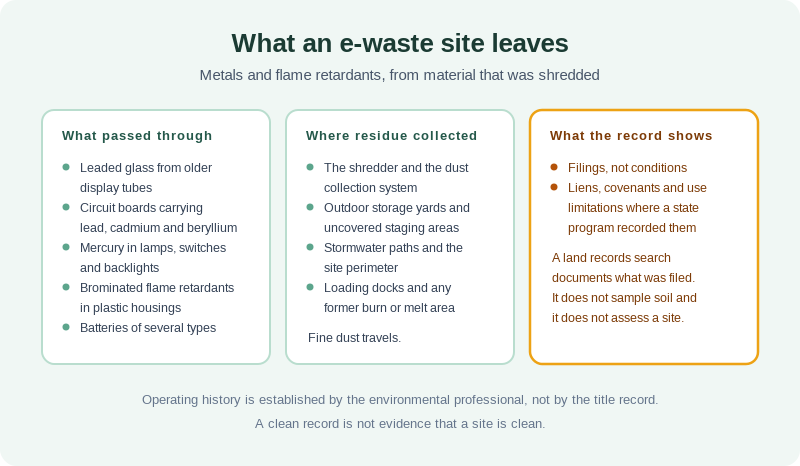
The material stream is the thing to understand. Leaded glass from older display tubes, circuit boards carrying lead, cadmium and beryllium, mercury in lamps, switches and backlights, brominated flame retardants in plastic housings, and batteries of several chemistries. All of it shredded, sorted and moved in volume.
Residue collects in places a tank based site does not have. The shredder and its dust collection system. Outdoor storage yards and uncovered staging areas where material sat through weather. Stormwater paths and the site perimeter, because fine dust travels. Loading docks, and any area where material was burned or melted to recover metal.
That is operating history rather than a title question, and establishing it is the environmental professional’s work under the standard. What it tells a searcher is where a regulator would have looked, which is where a recorded instrument would have come from if one was ever created.
Why the site hides in the chain
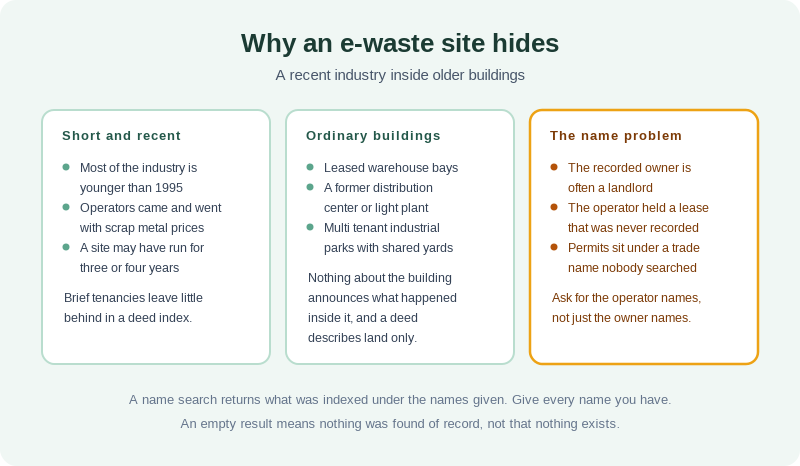
Three things make this site type hard to see. The industry is recent, so the operating period is short and often falls between two ordinary conveyances. The buildings are ordinary, typically leased warehouse bays, a former distribution center, or a unit in a multi tenant industrial park with a shared yard. And a deed describes land, not what happened inside a building.
The name problem is the one that costs the most. The recorded owner is frequently a landlord who never touched the material, the operator held a lease that was never recorded, and the permits sit under a trade name nobody thought to search. That is the same gap our note on an environmental lien search for leased property works through, and the fix is the same. Give us the operator names, not only the owner names.
Where the recorded instruments come from
When something does reach the land records on a site like this, it usually arrives by one of three routes, and knowing which one tells you how much weight to give it.
A state cleanup program is the most common. An operator leaves, a landlord discovers what is in the building, the state opens a file, and the parcel ends up carrying a lien, a covenant or an activity and use limitation when the file closes. Those instruments say what the land may be used for afterward, and they bind the next owner whether or not the next owner ever hears of the operator.
An enforcement action is the second. A judgment or a consent decree can be recorded against the parcel directly, or can show up only in the judicial index against the names involved. Which of those happened is a matter of practice in that jurisdiction rather than a rule.
The third route is a voluntary filing. An owner who cleaned a building to a standard sometimes records the closure letter, because a recorded letter is easier to produce in a future transaction than a file request. Nothing requires it, which is why its absence proves nothing.
What the search reads
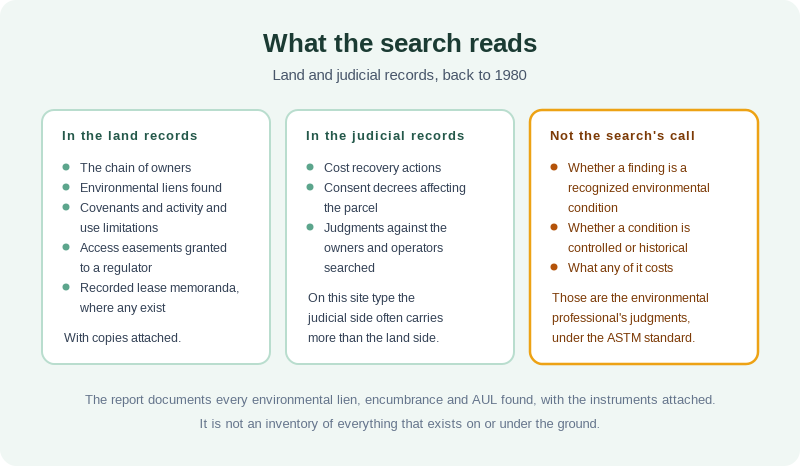
From the land records we report the chain of owners, every environmental lien found, covenants and activity and use limitations, access easements granted to a regulator, and any recorded lease memoranda, with the instruments attached.
The judicial side frequently carries more than the land side on this site type. Cost recovery actions, consent decrees affecting the parcel, and judgments against both the owners and the operators searched. Where an operator abandoned a building full of material, the enforcement record is often the only written trace, and the ASTM E1527-21 standard expects that search to be part of the inquiry.
What stays with the environmental professional is whether a finding is a recognized environmental condition, whether a condition is controlled or historical, and what any of it would cost. Those are judgments under the standard rather than findings an abstractor delivers, and our FAQ sets out where the line falls.
The takeaway
Recording practice varies by county, program practice varies by state, and an empty result means nothing was found of record rather than that a site is clean. On a parcel that also made electronics rather than only dismantling them, the chemistry and the records both change, which our note on a former semiconductor and electronics plant takes up.
The 1980 Environmental Lien & AUL report is where this starts. Certified title abstractors review land title and judicial records from 1980 to the present and document every environmental lien, encumbrance, and AUL found, with the recorded instruments attached. It’s $425, delivered by email in 3–5 business days. Order online, or look at a sample report first.
Get an E1527-21 compliant lien & AUL report
Our 1980 Environmental Lien & AUL reports are researched by certified title abstractors, cover judicial records, and are guaranteed accurate. Delivered in 3–5 business days.
or call 877-848-5337