Published
Composites manufacturing is one of the quieter industrial histories. A plant that laid up boat hulls, tanks, panels or pipe for twenty years looks, from the street, like any other light industrial building, and the chain of title on it usually reads the same way. The solvent and resin handling that went on inside is not something a deed records, which is the same problem our note on a former plastics and rubber plant describes from a neighboring industry.
What a composites plant handled
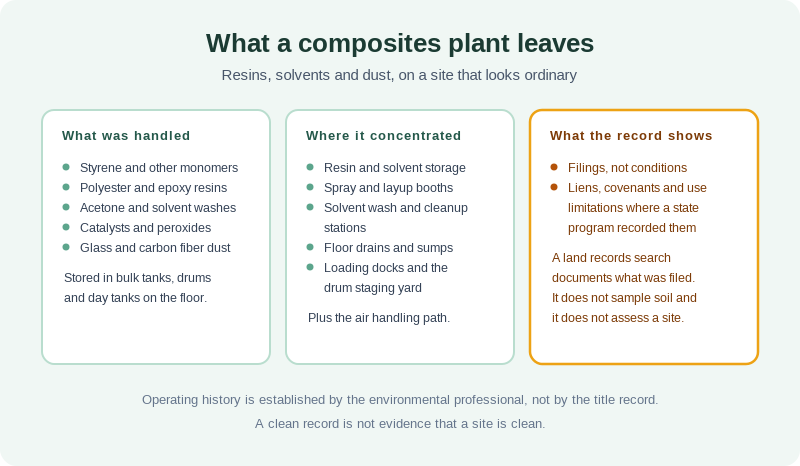
The materials are consistent across the industry. Styrene and other monomers, polyester and epoxy resins, acetone and similar solvent washes, organic peroxide catalysts, and the glass or carbon fiber dust that comes off cutting and finishing. Most of it arrived in bulk and moved through day tanks and drums on the production floor.
Where it concentrated is equally predictable. Resin and solvent storage, spray and layup booths, the solvent wash stations where tools and molds were cleaned, floor drains and sumps, loading docks, and the drum staging yard outside. Add the air handling path, because styrene control was often the first thing a regulator looked at.
None of that is a title question. It is the operating history an environmental professional establishes, and it belongs to the Phase I rather than to the records search. What it does tell a searcher is where to expect a filing if one was ever made, because the programs that generate recorded instruments are usually the ones that opened a file over a storage area, a floor drain or a release that reached soil.
How any of it reaches the land records
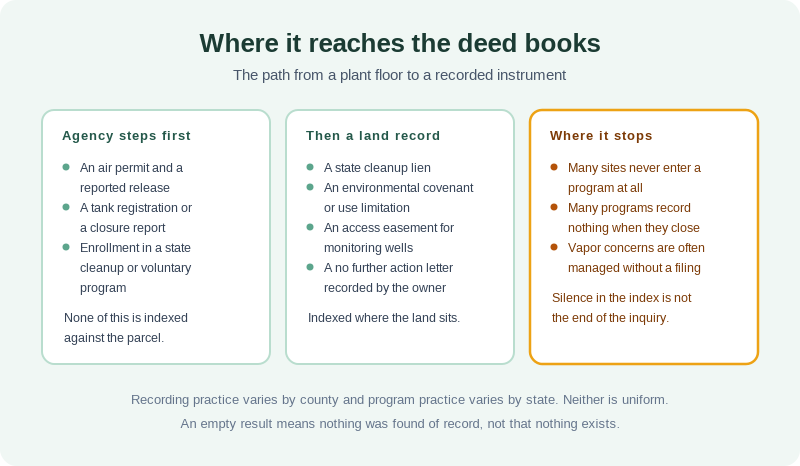
The agency steps come first and none of them is indexed against the parcel. An air permit, a reported release, a tank registration, a closure report, enrollment in a state cleanup or voluntary program. All of that sits in a regulator’s file, searchable by facility rather than by legal description.
A land record appears later, if it appears at all. A state cleanup lien, an environmental covenant or activity and use limitation, an access easement granted for monitoring wells, or a no further action letter that an owner chose to record. Those are the instruments a search reaches, and they are described in our note on what an AUL actually requires.
The chain frequently stops before that point. Plenty of sites never entered a program, plenty of programs record nothing when a file closes, and vapor concerns on a working building are often managed without any filing at all. Silence in the index ends one line of inquiry and not the whole inquiry, which is why the ASTM E1527-21 standard treats the lien and AUL search as one input among several.
What the search covers on a site like this
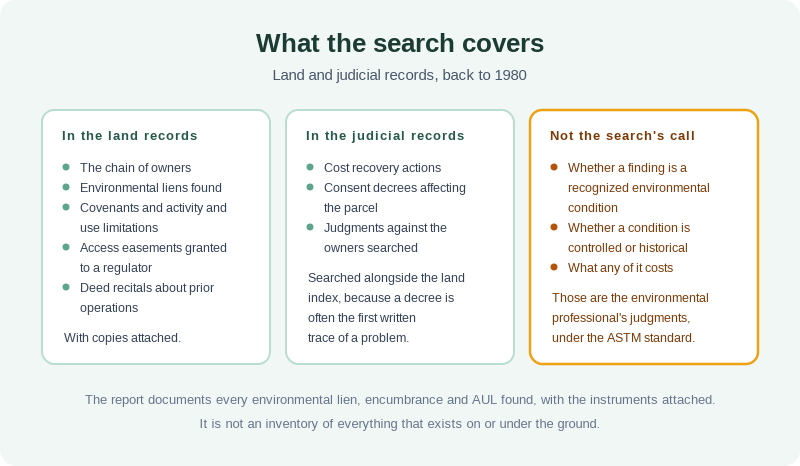
From the land records we report the chain of owners, every environmental lien found, covenants and activity and use limitations, access easements granted to a regulator, and any deed recital describing prior operations, with the instruments attached.
We search the judicial records alongside them, because on an older industrial parcel a cost recovery action or a consent decree is frequently the first written trace of a problem. Judgments against the owners searched come back in the same pass, and our note on a lien search for environmental professionals sets out how the two halves fit together.
The term searched matters here more than on a newer site. Composites manufacturing expanded sharply through the 1960s and 1970s, so a plant that closed in 1992 may have been running for thirty years before that, under owners who never appear in a short chain. A search reaching back to 1980 catches the closure and the decade after it. Where the question is who was operating before that, the longer chain of title is the one that answers it.
What we do not do is classify anything. Whether a finding is a recognized environmental condition, whether a condition is controlled or historical, and what any of it would cost are judgments for the environmental professional under the standard, not findings an abstractor delivers.
The takeaway
Recording practice varies by county and program practice varies by state, so no pattern described here holds everywhere, and an empty result means nothing was found of record rather than that the site is clean. On a marine or boat building parcel the same chemistry turns up alongside a different set of records, which our note on a former shipyard and marine repair site takes up.
The 1980 Environmental Lien & AUL report is where this starts. Certified title abstractors review land title and judicial records from 1980 to the present and document every environmental lien, encumbrance, and AUL found, with the recorded instruments attached. It’s $425, delivered by email in 3–5 business days. Order online, or look at a sample report first.
Get an E1527-21 compliant lien & AUL report
Our 1980 Environmental Lien & AUL reports are researched by certified title abstractors, cover judicial records, and are guaranteed accurate. Delivered in 3–5 business days.
or call 877-848-5337