
Published
Nursery and greenhouse ground is some of the most frequently redeveloped land on the edge of a growing city. It is flat, it is already cleared, it has water and three phase power, and the operation that was on it usually closed quietly rather than going through a bankruptcy that left a paper trail. For a Phase I that combination is worth slowing down for, because the exposures here differ from the former agricultural chemical dealer down the road even though the chemicals overlap.
Three areas, and one of them is the ground
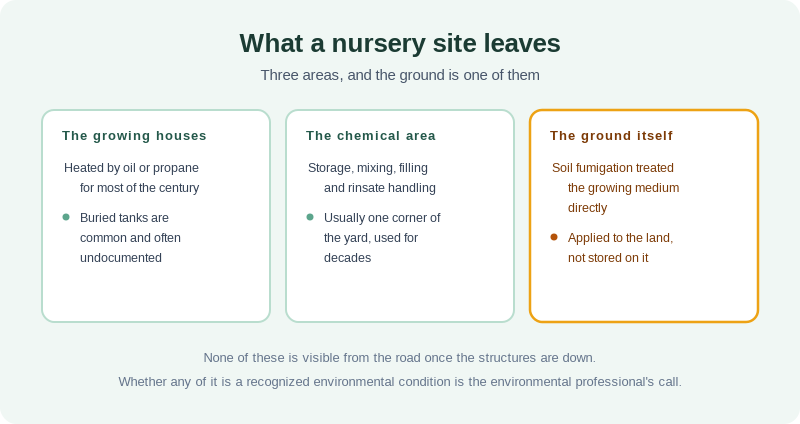
The growing houses are the obvious feature and the least interesting one once the glass is gone. What matters is how they were heated. Oil fired boilers were standard for most of the twentieth century, and the tank that served them is frequently buried, frequently undocumented, and frequently still there under what is now a parking area.
The chemical area is a single corner of the yard where storage, mixing, filling and rinsate handling happened for as long as the business ran. Insecticides, fungicides, herbicides and growth regulators were handled in concentrate there, and the rinse water went wherever it was convenient to send it. Concentration over time is what makes it worth finding.
The third is the one that separates this archetype from a warehouse. Soil fumigation treated the growing medium directly, which means the chemical was applied to the land rather than stored on it. Methyl bromide and chloropicrin were used widely for decades, and the practice leaves no tank, no shed and no structure to photograph. Hoop houses and poly structures were raised and moved as the business changed, so a footprint visible in a 1988 aerial photograph may bear no relation to what a site walk finds today.
Where the records sit
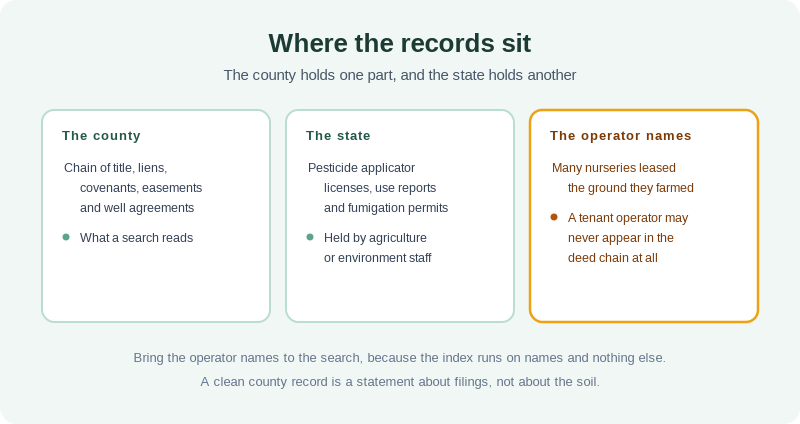
The county holds the chain of title, any recorded environmental lien, recorded covenants and use limitations, easements, and on an irrigated site the well and water agreements. That is what a records search reads, and on older nursery ground the water instruments are often the oldest documents on the parcel.
The state holds a different file. Pesticide applicator licenses, restricted use reports and fumigation permits sit with an agriculture or environment department, indexed by applicator and by site rather than against the deed. Ask for both files early, because a state records request runs on its own clock. Those are a separate request and they frequently turn out to be the most informative single source on what was applied and when.
Names are the practical problem. A great many nurseries leased the ground they farmed, sometimes for thirty years, so the operator who did everything described above may never appear anywhere in the deed chain. The names have to come from the client or from the site reconnaissance, which is the same constraint described in chain of title for a Phase I ESA.
What a lien and limitation search covers
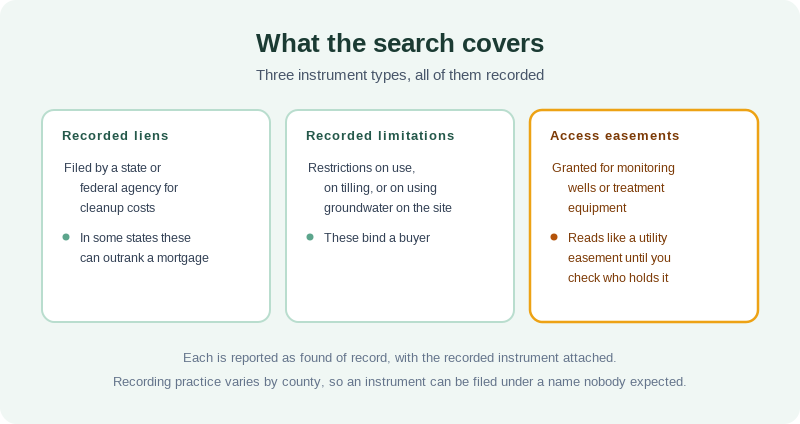
Three instrument types matter. A recorded environmental lien filed by an agency for cleanup costs, which in a number of states can take priority over a recorded mortgage. A recorded use limitation, where a site was closed with material left in place and the closure carried conditions on tilling, on soil disturbance or on groundwater use. And an access easement for monitoring wells or treatment equipment, which reads like an ordinary utility easement until somebody checks who holds it.
Arsenical pesticide residue in surface soil is a known issue on long farmed ground, and the parallel case is set out in orchard and farmland arsenic due diligence. Whether residue of that kind rises to a recognized environmental condition is the environmental professional’s judgment and not a search result. Where a formulation operation rather than an application history is in question, the pesticide formulation plant is the closer archetype. Our FAQ covers how the term and the scope are chosen.
The takeaway
A records search reports what was found of record in the indexes reviewed over the term searched, and a clean result is a statement about filings rather than about soil. Buried heating oil, a mixing corner and a fumigation history leave very little in a county index, so read a clean report alongside the site work rather than instead of it. The 1980 Environmental Lien & AUL report is the product that covers this. Certified title abstractors review land title and judicial records from 1980 to the present and document every environmental lien, encumbrance, and AUL found, with the recorded instruments attached. It’s $425, delivered by email in 3 to 5 business days. Order online.
Get an E1527-21 compliant lien & AUL report
Our 1980 Environmental Lien & AUL reports are researched by certified title abstractors, cover judicial records, and are guaranteed accurate. Delivered in 3–5 business days.
or call 877-848-5337