
Published
School buildings get reused more than almost any other institutional property. Districts consolidate, enrollment shifts, a religious order closes a campus, and the building becomes apartments, offices or a charter school. The structure usually looks sound and the setting is residential, which makes the site read as low risk. The history inside it argues otherwise, and it has more in common with the buildings in our note on former hospital and medical laboratory sites than with the neighborhood around it.
What a school site leaves behind
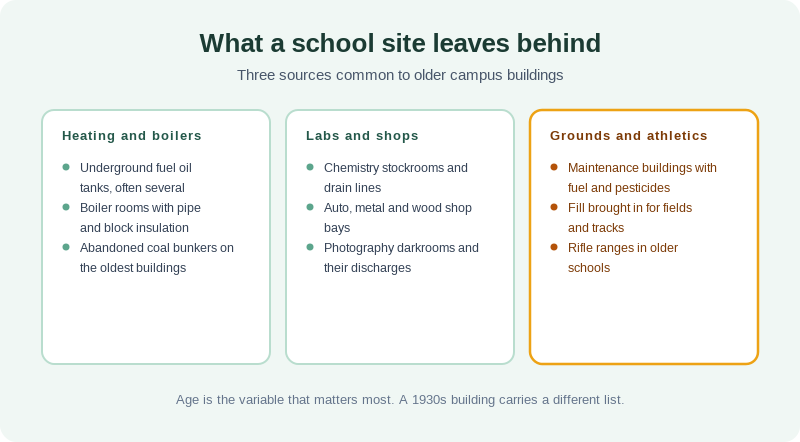
Heating is the first place to look. Older campuses ran on fuel oil, frequently from several underground tanks installed and abandoned across different decades, and the boiler rooms that burned it carry pipe and block insulation of their era. The oldest buildings sometimes still have a coal bunker behind a wall nobody has opened.
Labs and shops are the second. Chemistry stockrooms and the drain lines running out of them, auto, metal and wood shop bays, and photography darkrooms with their own discharges. A high school built in 1955 had a vocational wing, and that wing was a light industrial operation inside a school.
Grounds are the third and the easiest to overlook. Maintenance buildings with fuel and pesticide storage, fill brought in to level fields and tracks, and in a surprising number of older schools an indoor rifle range in the basement.
Who has held a school parcel
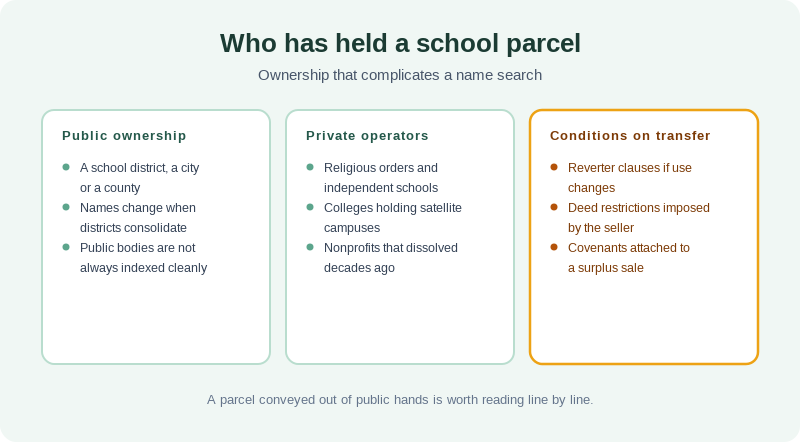
Public ownership complicates the names. A district, a city or a county held the ground, district names change when districts consolidate, and public bodies are not always indexed as cleanly as private parties. A parcel may sit under three versions of the same district’s name across sixty years.
Private operators bring a different problem. Religious orders and independent schools held campuses for generations, colleges kept satellite sites, and nonprofits that dissolved decades ago leave a name nobody can trace forward without a corporate filing.
The transfer out of public hands is the document to read line by line. Reverter clauses that return the land if the use changes, deed restrictions imposed by a selling district, and covenants attached to a surplus property sale are all common, and all of them are land records.
Why reuse projects find this late
Two reasons, and both are structural rather than careless. The first is that a school is an occupied, maintained building right up to the day it closes, so it presents as a working asset rather than a legacy site. Nobody walks a functioning gymnasium looking for a buried tank.
The second is that the records are split across bodies that do not talk to each other. A district holds its own facilities files, a municipality holds the permits, a state agency holds the tank registrations, and the county holds the land record. Only the last of those is indexed against the parcel, which means the land record is frequently the first place a reuse project learns that somebody else has already documented a condition. A recorded activity and use limitation is the clearest version of that, and our note on what an activity and use limitation actually requires sets out what one obliges an owner to do.
Timing matters too, because a school sale usually runs on a public calendar with a fixed closing date, and the search is quicker than any of the steps that follow it.
What a campus search covers
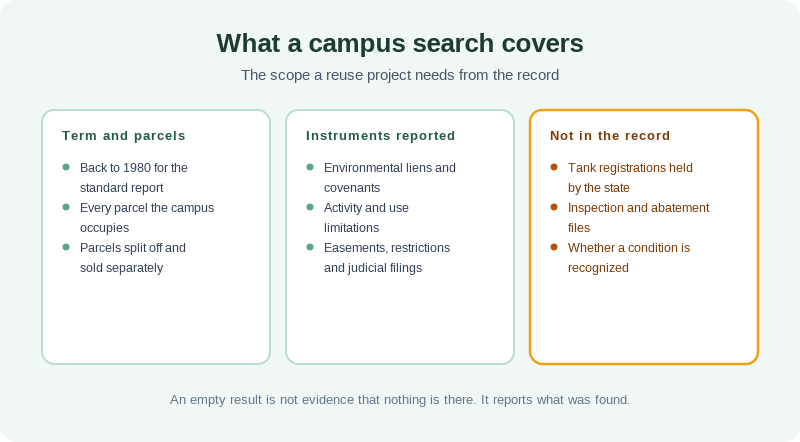
The term runs back to 1980 for the standard report, across every parcel the campus occupies, including parcels split off and sold separately, which on a large campus is the detail that decides whether the search reached the maintenance building.
What comes back is the environmental liens and covenants, the activity and use limitations, and the easements, restrictions and judicial filings found of record. What does not is held elsewhere. Tank registrations sit with a state agency, inspection and abatement files sit with the district or a health department, and whether a condition is recognized is the environmental professional’s judgment rather than the search’s.
Recording and indexing practice varies by county, and an empty result is not evidence that nothing is there. The report describes what was found of record over the term searched, and our FAQ sets out the scope. The standard the professional works to is in our note on the ASTM E1527-21 rule, and the sample report shows the form the findings take.
The takeaway
Date the buildings before you scope the search, since a 1920s campus, a 1955 one and a 1988 one carry three different lists. Run every parcel rather than the one on the purchase agreement, and read the deed that took the property out of public ownership before anything else in the chain.
Our 1980 Environmental Lien & AUL report is where this starts. Certified title abstractors review land title and judicial records from 1980 to the present and document every environmental lien, encumbrance, and AUL found, with the recorded instruments attached. It’s $425, delivered by email in 3–5 business days. Order online, or see our note on institutional control registries for where a recorded limitation is tracked afterward.
Get an E1527-21 compliant lien & AUL report
Our 1980 Environmental Lien & AUL reports are researched by certified title abstractors, cover judicial records, and are guaranteed accurate. Delivered in 3–5 business days.
or call 877-848-5337