Published
Sugar mills anchored towns across Louisiana, Florida, Hawaii, Texas and the beet growing states of the upper Midwest and Northwest, and most of them are gone. What they leave is a large flat industrial parcel beside a rail line and a water course, which is exactly the ground a developer wants. The diligence problem is that the mill was never the whole operation, and the acreage around it has its own history.
Three parts of the plant
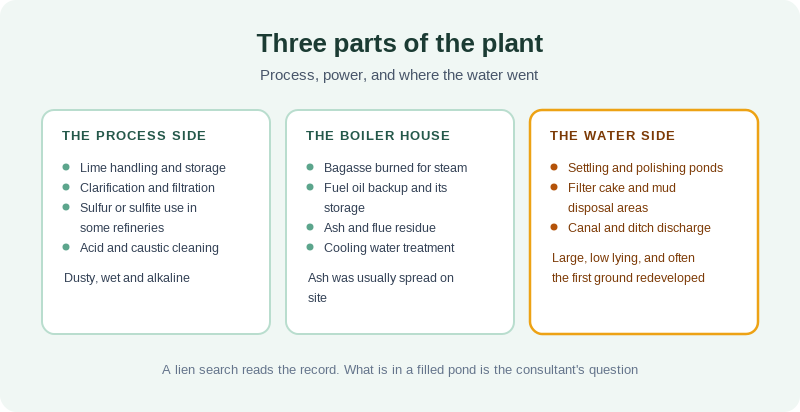
The process side is wet and alkaline rather than solvent driven. Lime handling and storage, clarification and filtration, acid and caustic cleaning cycles, and in some refineries a sulfur or sulfite step. It is not the chemistry people expect from heavy industry, and it is not nothing.
The boiler house burned bagasse, the fiber left after the cane is crushed, with fuel oil as backup. That produces ash and flue residue in quantity, and on most sites the ash was spread or bermed somewhere on the property rather than hauled away. Fuel oil storage sat nearby, frequently underground.
The water side is the largest footprint and the part that matters most. A mill moves an enormous volume of water, and the settling ponds, polishing ponds, filter cake disposal areas and discharge canals that handled it occupy low lying ground that later gets filled and built on. Those areas are the first thing to establish and the hardest to see from a road.
The parcel is the prior question
A mill rarely survives as one parcel. The plant site, the pond field, the rail spur and the office tract get separated, sold and renumbered, and the lot you are buying may be a corner of what was once the clarifier yard. Reconstructing that means following the land through the splits rather than searching the current description, which is the work set out in when an AUL covers a subdivided parcel.
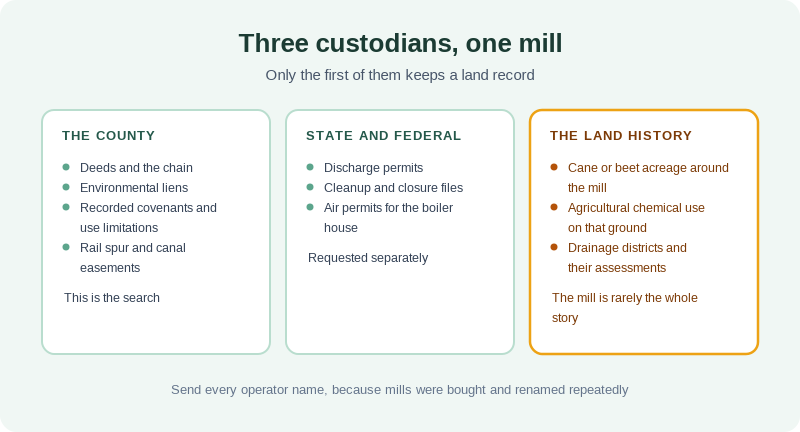
The county holds the chain, any environmental lien, recorded use limitations, and the easements including the rail spur and the canal rights, which are often the clearest surviving evidence of where the plant stood. State and federal files hold discharge permits, air permits for the boiler house and any cleanup record, and those are requested separately.
There is a third history that is easy to miss. The acreage surrounding a mill was cane or beet ground, farmed with the agricultural chemistry of its era, and that is a separate archetype rather than part of the mill. The reasoning is the same one in former agricultural chemical dealer due diligence, and where the surrounding land is in play it is worth saying so when the order goes in.
What a recorded restriction would look like here
Where a release was investigated and closed with material left in place, the conditions are frequently recorded, and on a mill site the usual ones are a restriction against residential use, a soil management plan governing excavation, a cap maintenance obligation over an ash or pond area, and a prohibition on groundwater extraction. The general mechanism is in environmental covenants and UECA, and reading one is covered in what an AUL actually requires.
A residential subdivision proposed over a filled settling pond is the case where one of those stops being paperwork, and it is a common proposal, because the pond field is the flattest land on the site.
Scoping the order
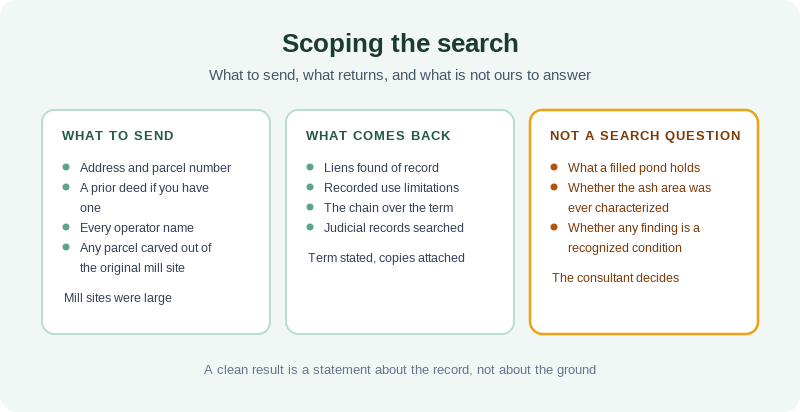
Send the address, the parcel number and a prior deed, since the legal description is what the recorder indexes against and mill descriptions change repeatedly. Name every operator, because these mills were bought, merged and renamed across a century of consolidation.
Flag the adjoining parcels that were part of the original works. Ponds and spoil areas sit at the edges, and the reasoning in adjoining property searches applies with full force where the neighbor was the same operation.
Term length is the last decision. Many mills closed between the 1970s and the 2000s, so a window opening in 1980 catches the closure, the cleanup and the redevelopment while the operating decades sit above it, and why 1980 is the search date explains the reasoning.
The takeaway
A records search reports what was found of record in the indexes reviewed over the term searched, and a clean result is a statement about the record rather than about the ground. What a filled pond holds, whether an ash area was ever characterized, and whether any finding is a recognized environmental condition are judgments for the environmental professional. The 1980 Environmental Lien & AUL report is the product that covers this. Certified title abstractors review land title and judicial records from 1980 to the present and document every environmental lien, encumbrance, and AUL found, with the recorded instruments attached. It’s $425, delivered by email in 3 to 5 business days. Order online, or read the chain of title behind a Phase I if you are still deciding how far back to go.
Get an E1527-21 compliant lien & AUL report
Our 1980 Environmental Lien & AUL reports are researched by certified title abstractors, cover judicial records, and are guaranteed accurate. Delivered in 3–5 business days.
or call 877-848-5337