Published
Wire and cable plants are among the most reliably overlooked industrial sites in the country, and the reason is almost entirely clerical. They ran for decades under one owner, they were named after the family or the town rather than the product, and the chain of title they produced is four or five instruments long. A short chain reads as an uneventful one. On this property type it means only that nobody sold the place.
Two processes, two kinds of residue
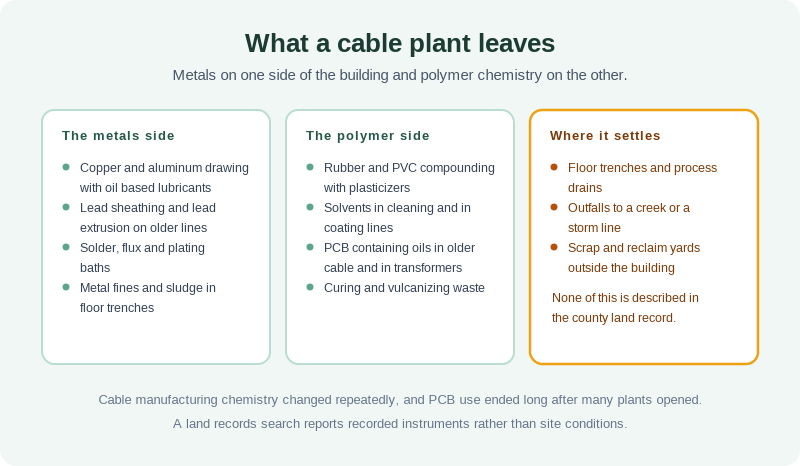
The metals side starts with drawing. Copper and aluminum are pulled through dies with oil based lubricants, which generates fines and sludge that collect in floor trenches. Older plants sheathed cable in lead, and lead extrusion leaves a signature that persists in soil for as long as anyone cares to measure it. Solder, flux and plating baths add their own metals.
The polymer side is separate ground, often at the other end of the same building. Rubber and PVC compounding with plasticizers, solvents in cleaning and coating lines, and curing waste. The item that matters most is the one that was ordinary for decades, which is PCB containing oil, used in cable and sitting in the transformers that powered the plant. Its use in new equipment ended long after many of these works opened.
Where it all settles is consistent. Floor trenches and process drains, an outfall to a creek or a storm line, and the scrap and reclaim yard outside the building. None of that appears in a deed.
Why the chain stays quiet
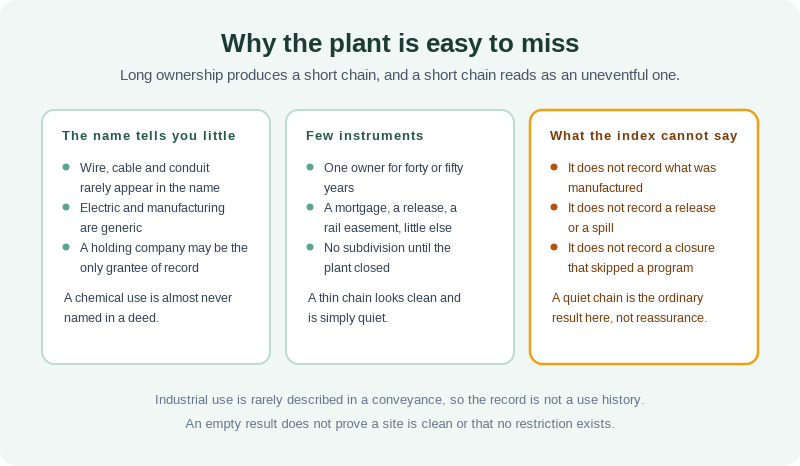
The name tells you very little. Wire, cable and conduit rarely appear in a grantee name. Electric and manufacturing are generic enough to cover anything. A holding company may be the only entity of record. And a conveyance almost never describes what was made on the land.
The instrument count is low for an ordinary reason. One owner for forty or fifty years produces a mortgage, a release, a rail easement and not much else, and no subdivision occurs until the plant closes. That thinness is what makes these sites feel clean on a quick look.
The index cannot say what was manufactured, cannot record a release, and cannot record a closure that skipped a state program. A quiet chain here is the normal output, the same point our note on a former telephone exchange makes about another long held utility property.
What a search of this site reads
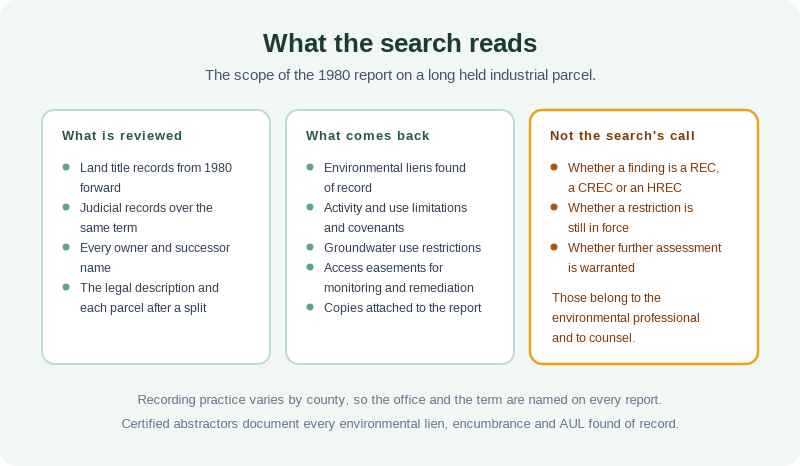
Land title records from 1980 forward, judicial records over the same term, every owner and successor name, and the legal description along with each parcel created if the site was later split. What comes back is the environmental liens found of record, activity and use limitations and covenants, groundwater use restrictions, and access easements for monitoring and remediation, each with a copy attached.
Successor names matter more here than on most property types. Cable manufacturers consolidated heavily, and the entity that operated the plant in 1974 is frequently three mergers removed from the name on the last deed. Running only the grantor of record misses the term that counts.
What the report does not decide is whether a finding is a recognized environmental condition, whether a restriction remains in force, or whether further assessment is warranted. Those belong to the environmental professional and to counsel, a line the ASTM E1527-21 guide sets out in detail. Recording practice varies by county, so an empty result is a statement about the record searched rather than about the ground.
Setting the scope before you order
Three decisions shape whether the report answers the question you actually have.
The first is the parcel set. Many of these works grew by buying the lot next door, so the operating footprint and the current tax parcels rarely line up. Order against the legal description for every parcel the plant occupied, not just the one the building sits on today. Where the site was broken up for redevelopment, each resulting lot carries its own chain and its own instruments.
The second is the name list. Supply the current owner, every prior owner you can identify, and the operating entities where they differ, which on leased industrial ground they usually do. A search is only as wide as the names it is given.
The third is the adjoining ground. Lead and solvents migrate, and a parcel downgradient of a cable works can carry a restriction recorded as part of someone else’s cleanup. Where the neighboring site is the concern rather than the subject site, our note on an adjoining property environmental lien search covers how that order is scoped.
Ordering it
The 1980 Environmental Lien & AUL report is built for exactly this. Certified title abstractors review land title and judicial records from 1980 to the present and document every environmental lien, encumbrance, and AUL found, with the recorded instruments attached. It’s $425, delivered by email in 3–5 business days. Order online, look at a sample report first, or check the FAQ for what we need to start. A foundry on an adjoining lot raises the same metals questions, covered in a former foundry and metal casting site.
Get an E1527-21 compliant lien & AUL report
Our 1980 Environmental Lien & AUL reports are researched by certified title abstractors, cover judicial records, and are guaranteed accurate. Delivered in 3–5 business days.
or call 877-848-5337