Published
Compressor stations are easy to underestimate because they are small. A few acres, a fenced yard, a metal building and some piping, sitting in farmland or at the edge of a town, and nothing about the footprint suggests a heavy industrial history. The activity inside one was concentrated rather than large, and the record it leaves is split between a county recorder and a state or federal regulator. The chain work is the discipline described in our note on the former bulk petroleum terminal, on a shorter site with a longer list of owner names.
What a station actually did
A compressor station raises the pressure of natural gas so it can keep moving down a transmission line. A pump station does the same job for a liquid. Either way the equipment runs continuously for decades, and the consumables are the issue.
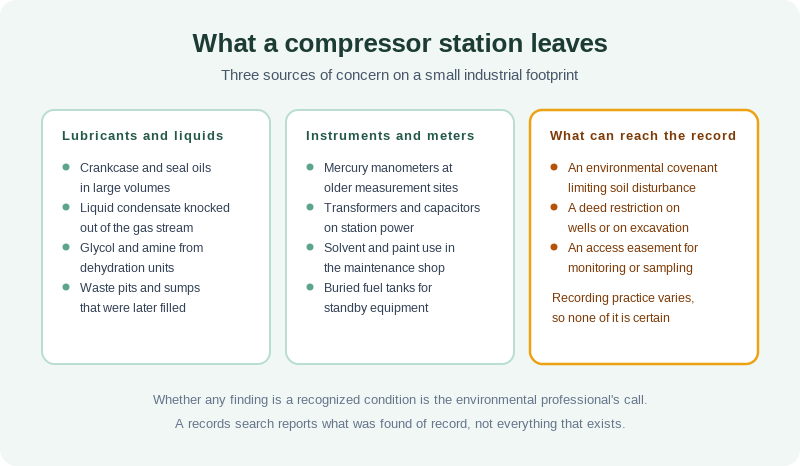
Large reciprocating engines consume crankcase and seal oil in volumes that have to go somewhere, and older stations handled waste oil on site rather than hauling it away. Condensate knocks out of the gas stream and was frequently collected in pits. Dehydration units run glycol or amine. Shops used solvents and paints, standby equipment ran from buried tanks, and measurement at older sites used mercury manometers.
None of that makes a station a contaminated site. It describes the questions a consultant will have, and it tells you why the recorded file is worth reading before a Phase I scope is set.
The owner names are the hard part
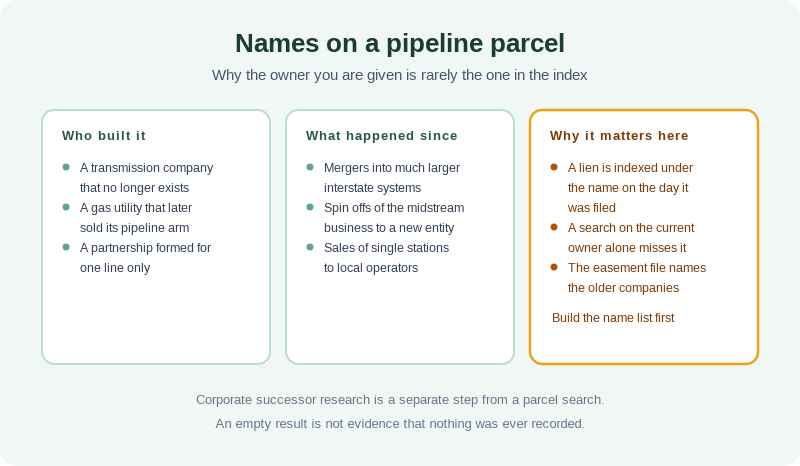
Pipeline ownership has churned more than almost any other industry. The company that built a station in 1951 may have been a transmission company that no longer exists, a gas utility that later sold its pipeline arm, or a partnership formed to build one line. Since then there have been mergers into much larger interstate systems, spin offs of midstream assets into new entities, and sales of individual stations to local operators.
That matters because an instrument is indexed under the name on the day it was filed. A lien recorded against a company in 1978 does not move to the index entry of the company that bought it in 2003. A search run on the current owner alone will miss it, and the easement file for the line itself is usually written in the names of companies nobody remembers. Build the name list before the search runs rather than after, the same way our note on tracing a corridor approaches a rail property.
The easement is part of the parcel
A station exists because a line runs to it, and the line is a recorded relationship that usually outlives the station. Transmission easements are old, they are frequently wide, and they are written in terms that nobody drafting a deed today would use. A right to lay, maintain, operate, repair, replace and remove one or more lines of pipe is not the same grant as a right to a single pipe, and the difference decides what can be built on the strip afterward.
Two things are worth checking on a retired station parcel. The first is whether the easement was ever released. A station that stopped operating in 1992 may still carry a live easement, because abandoning a use is not the same act as releasing a right, and the release has to be recorded to show up. The second is what is still in the ground, since lines are regularly abandoned in place rather than removed and a recorded abandonment is the exception.
What the search covers
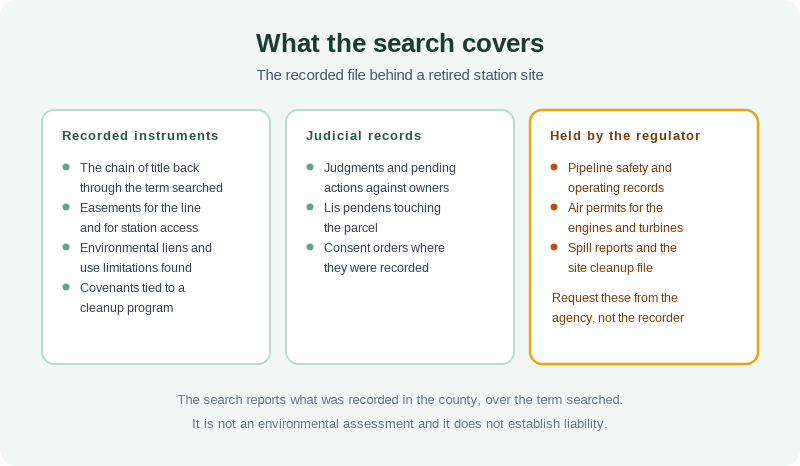
Over the term searched we report the chain of title, the easements for the line and for station access, any environmental lien or activity and use limitation found of record, and covenants tied to a state cleanup program. We also report judicial records, meaning judgments and pending actions against the owner names, lis pendens touching the parcel, and consent orders where somebody recorded them. The frequently asked questions cover what we need from you to scope that.
The regulator holds a different file entirely. Pipeline safety and operating records, air permits for the engines and turbines, spill reports and the site cleanup file all sit with a federal or state agency and have to be requested there. Whether a finding is a recognized environmental condition is the environmental professional’s judgment rather than ours, which is the division our note on REC, CREC and HREC sets out.
The takeaway
Treat a small station site as an industrial parcel with a complicated corporate history, and give the search every name you can find before it starts. A records search reports what was found of record in the county searched over the term searched, so a clean result means nothing was found rather than that nothing exists.
The 1980 Environmental Lien & AUL report is where that work gets done. Certified title abstractors review land title and judicial records from 1980 to the present and document every environmental lien, encumbrance, and AUL found, with the recorded instruments attached. It’s $425, delivered by email in 3-5 business days. Order online, or read our note on how the search is performed first.
Get an E1527-21 compliant lien & AUL report
Our 1980 Environmental Lien & AUL reports are researched by certified title abstractors, cover judicial records, and are guaranteed accurate. Delivered in 3–5 business days.
or call 877-848-5337