Published
Every deal has a moment where somebody asks whether the full environmental report is really necessary, and the honest answer is that a lighter option exists and is sometimes appropriate. The transaction screen process is a real ASTM standard with a real purpose. It is also a different instrument from a Phase I, written to answer a narrower question, and the difference matters most in the one situation people usually have in mind when they ask. Anyone weighing the two should start with the all appropriate inquiries rule, because that is where the distinction becomes concrete.
What a screen actually is
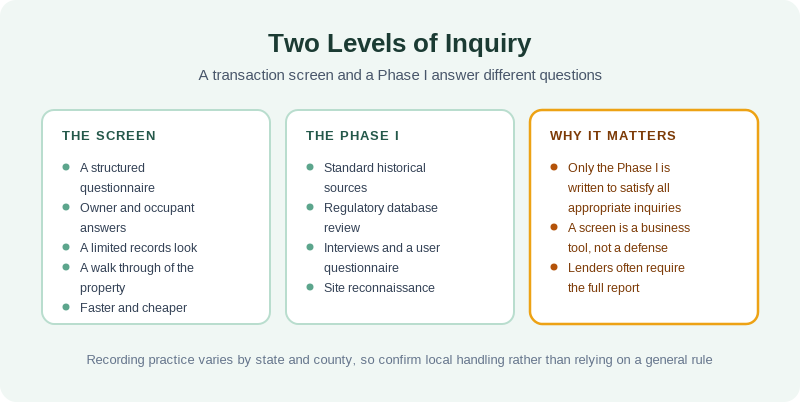
A transaction screen is a structured questionnaire. Somebody familiar with the property answers a defined set of questions, an inquiry is made of the owner and occupants, a limited look is taken at available records, and the property is walked. It can be performed by a non-specialist, and that is deliberate, because the point of the standard is to give a party a quick and inexpensive first read.
Used that way it is genuinely useful. A screen can clear an obviously low risk property early, or raise enough concern to justify spending real money on a full assessment. What it cannot do is substitute for the inquiry a buyer relies on when a liability defense is in play.
What a screen leaves out
The gaps are not small, and they are concentrated in exactly the places a records specialist pays attention to.
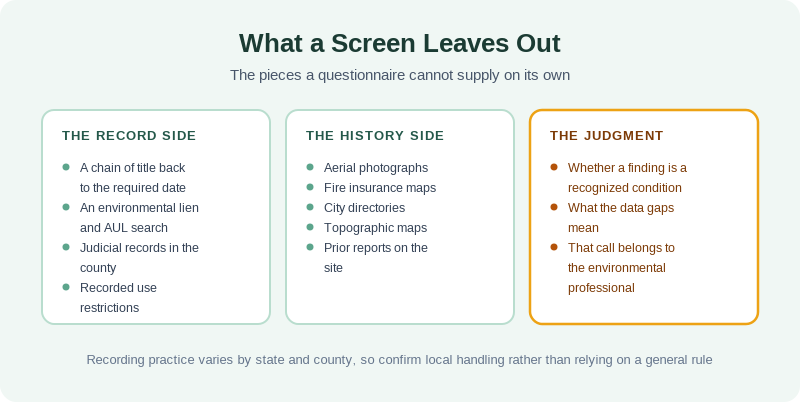
- The record side. A chain of title back to the required date, the environmental lien and AUL search, judicial records in the county, and recorded use restrictions are all part of the full inquiry. The chain of title review is a substantial part of that work.
- The history side. Aerial photographs, fire insurance maps, city directories and topographic maps are the standard historical sources, and they are what reveal a use nobody still living remembers.
- The judgment. Whether a finding rises to a recognized environmental condition is a call made by an environmental professional, as described in REC, CREC and HREC. A questionnaire does not produce that conclusion.
Data gaps also behave differently. In a full assessment they are identified, described and evaluated, which is a discipline covered in data gaps in an environmental lien search. A screen simply has less to be missing.
Where each one fits
A screen can be a reasonable choice for an early look before anyone has committed, for property that has been office or residential throughout, for a portfolio triage pass where you need to rank sites rather than clear them, or where no industrial or fuel history turns up anywhere.
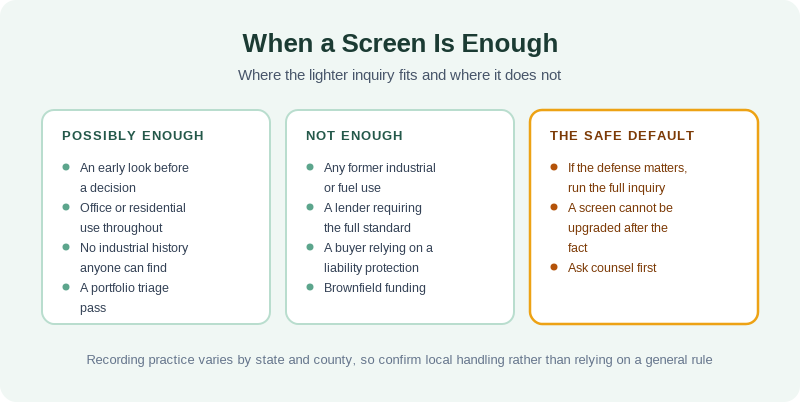
It is not enough where there is any former industrial, fuel, dry cleaning or vehicle service use, where a lender requires the full standard, where brownfield funding is involved, or where the buyer intends to rely on a landowner liability protection. The obligations that follow such a purchase are set out in BFPP continuing obligations, and they start from a properly conducted inquiry.
The timing problem
A screen cannot be converted into a Phase I after the fact. If the transaction closes on the strength of a screen and a question arises later, the inquiry that was required had to have been completed before acquisition, not reconstructed afterward. That is also why the 180 day shelf life rule matters so much, and why the sequence is worth setting early rather than improvising.
The practical rule most consultants settle on is simple enough. If the defense matters, run the full inquiry. If you are deciding whether to keep looking at a property at all, a screen may save you the cost of looking further.
What the records side contributes either way
Whichever route a buyer takes, the recorded picture is its own question. Liens and activity and use limitations are filed in the county land records, and they bind the land rather than the party who created them. A buyer who skips that search is relying on a seller’s account of what was agreed with a regulator, which is not the same as reading what was recorded against the parcel. Our FAQ covers how we scope that work, and a sample report shows what comes back.
The 1980 Environmental Lien & AUL report is where that fits. Certified title abstractors review land title and judicial records from 1980 to the present and document every environmental lien, encumbrance, and AUL found, with the recorded instruments attached. It’s $425, delivered by email in 3–5 business days. Order online, or read user responsibilities in a Phase I if you are still deciding which level of inquiry your transaction needs.
Get an E1527-21 compliant lien & AUL report
Our 1980 Environmental Lien & AUL reports are researched by certified title abstractors, cover judicial records, and are guaranteed accurate. Delivered in 3–5 business days.
or call 877-848-5337