Published
Vapor migration became a formal part of the Phase I conversation when the standard began treating it as a contaminant pathway rather than a separate topic, and most consultants now address it inside the report rather than alongside it. There is also a distinct ASTM guide written for the question on its own, and the relationship between the two is a source of recurring confusion for buyers and lenders reading a scope of work. Our post on vapor intrusion and recorded use restrictions covers the records side. This one covers the screen.
Two ways the question enters a review
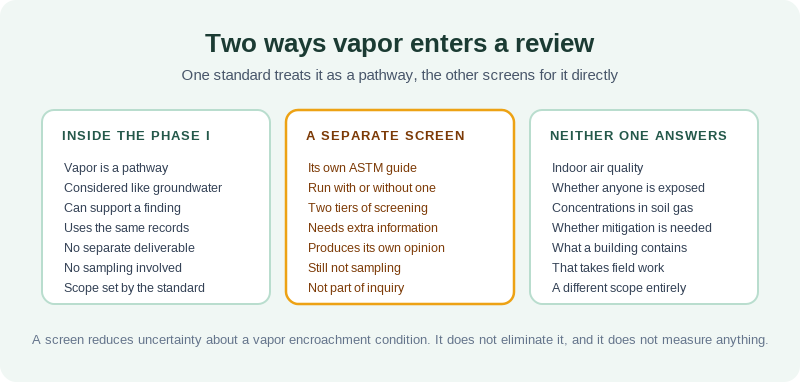
Inside a Phase I, vapor is handled like any other pathway. It draws on the same historical sources and the same regulatory database review, it can support a finding, and it produces no separate deliverable. The scope is set by the Phase I standard itself, which our guide to the E1527-21 rule sets out in full.
A vapor encroachment screen is its own exercise under its own guide. It can be run alongside a Phase I or entirely independently, it asks for information beyond what a Phase I collects, and it produces its own conclusion about whether a vapor encroachment condition exists. It is a screening process rather than an investigation, and it is not itself a component of all appropriate inquiries.
Neither approach measures anything. Indoor air quality, soil gas concentrations, actual exposure, and whether mitigation is warranted all require field work that sits outside both scopes.
How the two tiers work
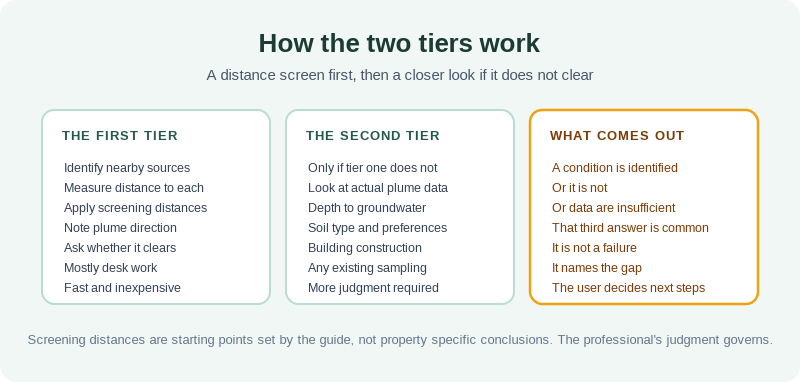
The first tier identifies known or suspected contaminant sources near the property, measures the distance to each, and applies screening distances to ask whether the question clears on geography alone. It leans on the same standard historical sources a Phase I already compiles, so much of the work is already in hand.
Where tier one does not clear, a second tier looks more closely at plume data, depth to groundwater, soil type, preferential pathways, and building construction. More judgment is required and so is more information.
Three outcomes are possible. A condition is identified, it is not, or the available data are insufficient to say. That third answer is common and it is not a failure of the work. It names a gap, in the same way a Phase I names a data gap, and it leaves the next decision with the user.
Why the third outcome matters most
Buyers tend to read an inconclusive screen as a problem with the consultant. It is usually a problem with the information available, and naming it is the useful part of the work.
Insufficient data on a vapor question commonly means a nearby release is documented but the plume was never delineated, or the depth to groundwater is unknown, or the building’s slab and foundation details are not on file. Each of those is an answerable question, and knowing which one is open is what lets a buyer decide whether to sample, to negotiate, or to accept the uncertainty with a mitigation allowance. An inconclusive screen that identifies the gap is more useful than a confident one built on an assumption nobody tested.
Where it meets the land record
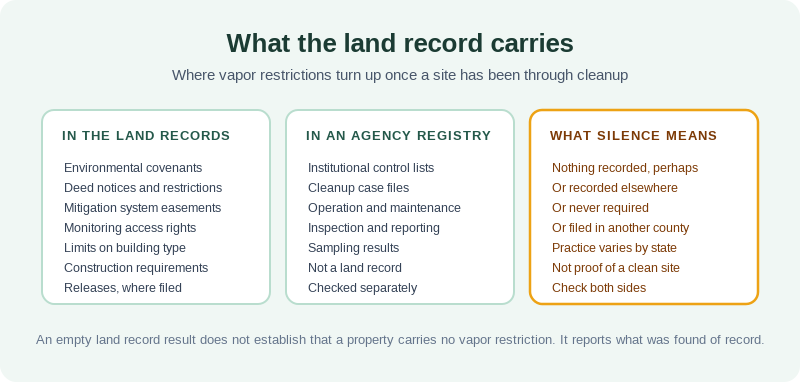
A screen looks forward at a condition. The land record looks backward at what a previous cleanup left behind, and on a site that has been through a state program the two meet. Environmental covenants, deed notices, mitigation system easements, monitoring access rights, and limits on building type or construction method are all recorded instruments, and our post on environmental covenants under UECA covers the statutory framework most states use for them.
Plenty of the obligation sits elsewhere. Operation and maintenance requirements, inspection and reporting duties, and sampling results are agency records, and institutional control registries are a separate check from a records search. A land record that returns nothing does not establish that a property carries no vapor restriction. It may have been recorded in another county, filed only with the agency, or never required at all, and recording practice varies by state.
Whose call it is
Worth saying plainly, because it is the same division that governs a Phase I. Whether a vapor encroachment condition exists, and whether any finding rises to a recognized environmental condition, is the environmental professional’s judgment. Our post on REC, CREC and HREC covers that classification, and the same reasoning applies to a screen as to a transaction screen. A records search reports instruments. It does not characterize them.
The 1980 Environmental Lien & AUL report is the records half of that picture. Certified title abstractors review land title and judicial records from 1980 to the present and document every environmental lien, encumbrance, and AUL found, with the recorded instruments attached. It’s $425, delivered by email in 3-5 business days. Order online, see a sample report, or read the FAQ if you want to know what the term covers first.
Get an E1527-21 compliant lien & AUL report
Our 1980 Environmental Lien & AUL reports are researched by certified title abstractors, cover judicial records, and are guaranteed accurate. Delivered in 3–5 business days.
or call 877-848-5337