
Published
Metal container plants sat beside canneries, breweries and food processors across the country, and the packaging industry consolidated hard enough from the 1980s onward that a great many of them closed. What is left is a long single story building on a rail spur with a large yard, usually in an older industrial district that is now being looked at for something else. It behaves differently from the former machine shop next door, and the difference is worth knowing before the order goes in.
Three lines in one building
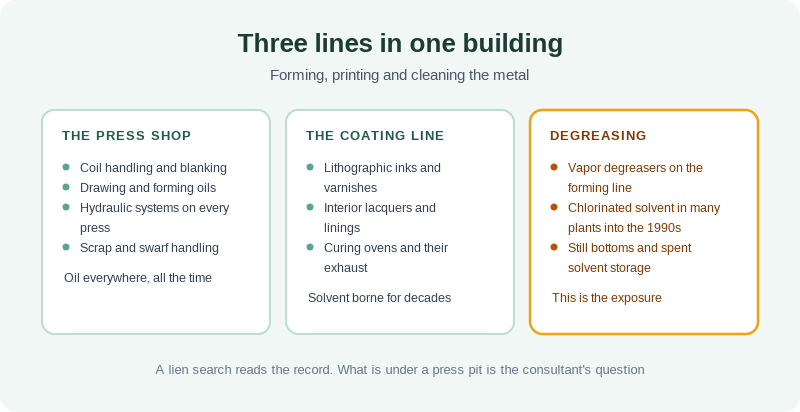
The press shop formed the metal. Coil handling, blanking, drawing and forming presses, each running hydraulic systems and each using forming oil in volume. Oil ends up in pits, in trenches, in the floor and in the scrap. This is the most ordinary part of the plant and it accounts for a lot of the staining.
The coating line printed and lined the sheet. Lithographic inks, varnishes, interior lacquers and the curing ovens that set them, all solvent borne for most of the industry’s history. Ink and coating storage, mixing and the solvent used to wash the line are a second and quite separate inventory.
The third is the one that defines the archetype. Vapor degreasing was standard practice for cleaning formed metal, and chlorinated solvent remained in use in many plants well into the 1990s. The degreaser itself, the still bottoms and the spent solvent storage are the exposure that matters, for the same reasons set out in vapor intrusion and recorded use restrictions.
Where the records sit
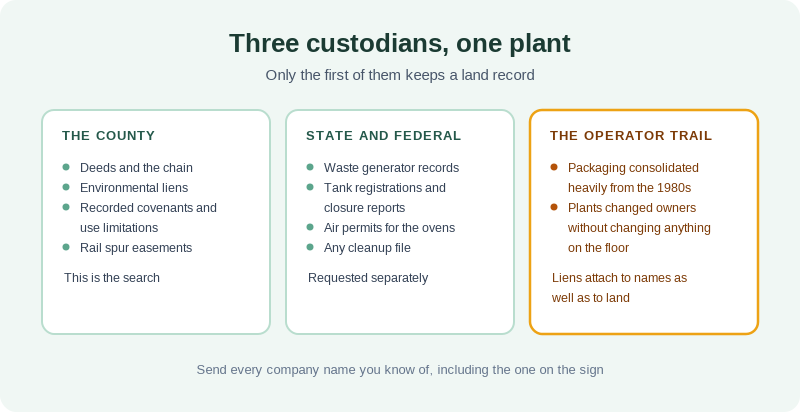
The county holds the chain, any environmental lien, recorded covenants and use limitations, and the easements, among which the rail spur right of way is frequently the oldest instrument on the parcel. That is what a search reads.
State and federal files hold the waste generator records, tank registrations and closure reports, air permits for the curing ovens and any cleanup record. Those are requested separately and they are usually where the detail lives.
The third custodian is the corporate trail, and on this archetype it is unusually tangled. Packaging consolidated through decades of mergers, and plants changed owners repeatedly without anything on the floor changing at all. Liens attach to names as well as to land, so the operator history is part of the search rather than background to it, which is the point made in how an environmental lien and AUL search is performed.
What a recorded restriction would look like
Where a release was investigated and closed with contamination left in place, the conditions are frequently recorded against the land. On a plant of this kind the usual ones are a restriction to commercial or industrial use, a prohibition on groundwater extraction, a soil management plan governing excavation, and a vapor mitigation obligation where a building remains in use.
Those instruments are exactly what a search is reading for, and the general shape is covered in what is an activity and use limitation. A conversion to residential or mixed use over a former degreaser area is the case where one of them becomes the governing constraint on the whole project.
Scoping the order
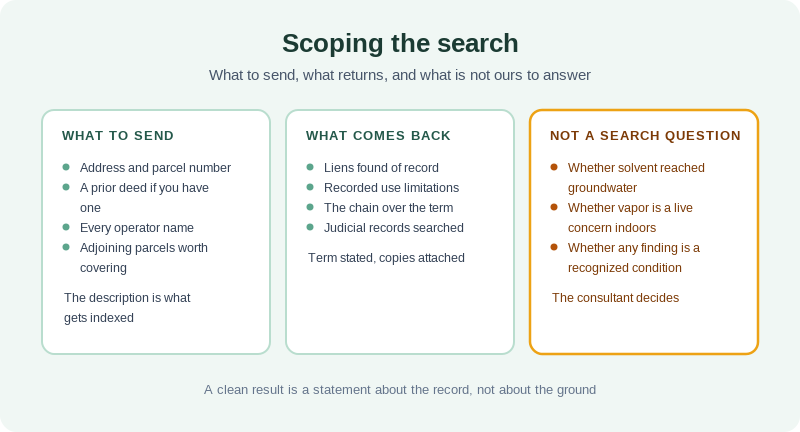
Send the address, the parcel number and a prior deed, since the legal description is what the recorder indexes against. Name every operator you know of, including the company whose name was on the building, which is often not the entity that held title.
Flag adjoining parcels. These plants were built next to the customer they supplied, so the cannery or brewery beside the site is a separate operation with a separate history, and adjoining property searches covers when that is worth adding.
Term length is the remaining decision. Many of these plants closed between the 1980s and the early 2000s, so a window opening in 1980 catches the closure and the redevelopment while the busiest operating decades sit above it. Whether that matters depends on what the file is for, and why 1980 is the search date covers the reasoning.
The takeaway
A records search reports what was found of record in the indexes reviewed over the term searched, and a clean result is a statement about the record rather than about the ground. Whether solvent reached groundwater, whether vapor is a live concern indoors, and whether any finding is a recognized environmental condition are judgments for the environmental professional. The 1980 Environmental Lien & AUL report is the product that covers this. Certified title abstractors review land title and judicial records from 1980 to the present and document every environmental lien, encumbrance, and AUL found, with the recorded instruments attached. It’s $425, delivered by email in 3 to 5 business days. Order online, or read the former metal plating shop if the surface finishing side is what concerns you.
Get an E1527-21 compliant lien & AUL report
Our 1980 Environmental Lien & AUL reports are researched by certified title abstractors, cover judicial records, and are guaranteed accurate. Delivered in 3–5 business days.
or call 877-848-5337