Published
Most of the attention on landowner liability protection goes to the bona fide prospective purchaser, which makes sense, because it is the one written for a buyer who knows the property is contaminated and wants it anyway. It is not the only route. Two others sit beside it, and all three run through the same gate. If you have read the post on BFPP continuing obligations after closing, this is the wider frame around it.
Three doors, one corridor
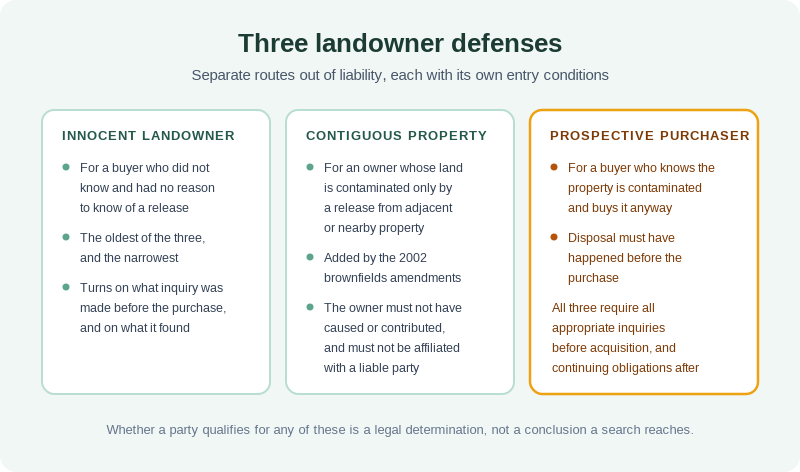
The innocent landowner defense is the oldest and the narrowest. It is for a buyer who did not know and had no reason to know that a release had occurred, and it turns entirely on what inquiry was made before the purchase and on what that inquiry found.
The contiguous property owner provision came in with the 2002 brownfields amendments. It is for an owner whose land is contaminated only by a release from adjacent or nearby property owned by somebody else. The owner must not have caused or contributed to the release, and must not be affiliated with a party that is liable for it.
The bona fide prospective purchaser route is the one buyers usually ask about. It accommodates a purchaser who knows about the contamination, provided the disposal happened before the acquisition.
Three different situations, and the same two requirements behind each one.
What they all require
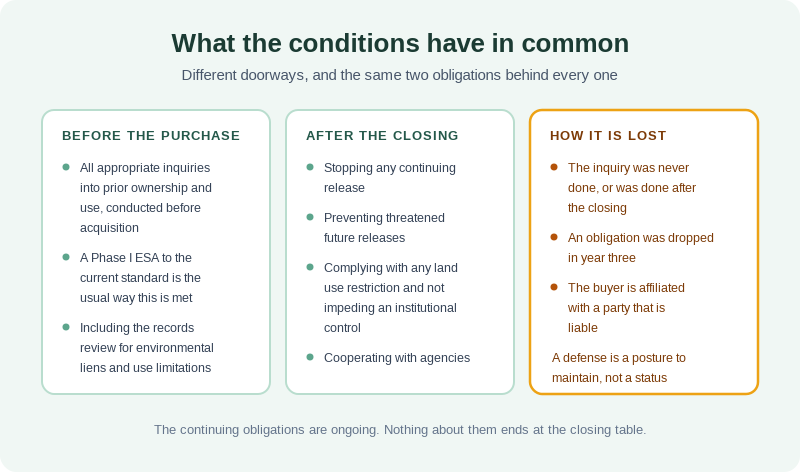
Before the purchase, all appropriate inquiries into prior ownership and use, conducted before acquisition rather than after it. A Phase I ESA to the current standard is the usual way this is satisfied, and the user responsibilities the standard assigns to the buyer are part of it. So is the records review for environmental liens and activity and use limitations, which is the piece a consultant cannot perform from the historical sources alone.
After the closing, the continuing obligations. Stopping any continuing release, preventing threatened future releases, complying with any land use restriction and not impeding an institutional control, and cooperating with the agencies. These are ongoing. Nothing about them ends at the closing table.
How the protection is lost is worth saying plainly. The inquiry was never done, or was done after the closing. An obligation was quietly dropped in year three. The buyer turns out to be affiliated with a liable party. A defense is a posture to maintain, not a status to acquire.
Where the land record comes in
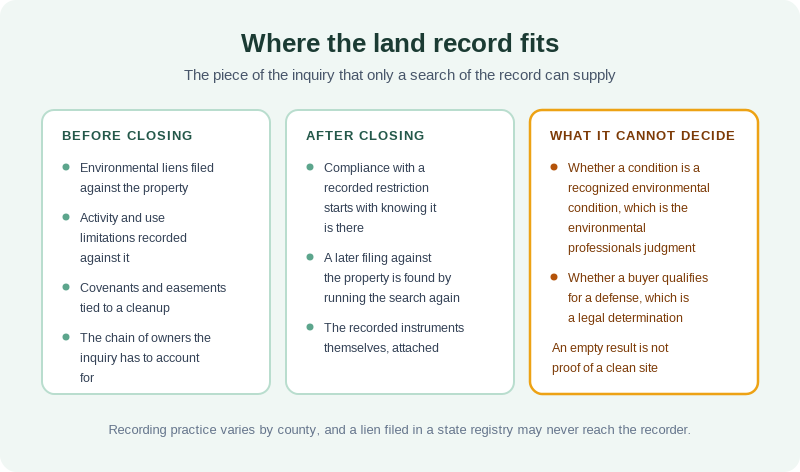
Before closing, the search supplies environmental liens filed against the property, activity and use limitations recorded against it, covenants and easements tied to a cleanup, and the chain of owners the inquiry has to account for. The chain of title is doing double duty here, because the contiguous property provision asks who owns the neighboring ground as well.
After closing, the record keeps mattering. Complying with a recorded restriction starts with knowing it is there, and a later filing against the property is found by running the search again. Shelf life is not just a Phase I question, as the post on the 180 day rule sets out.
What the search cannot decide is whether a condition is a recognized environmental condition, which belongs to the environmental professional, or whether a buyer qualifies for a defense, which is a legal determination. An empty result is not proof of a clean site, recording practice varies by county, and a lien filed in a state registry may never reach the recorder at all.
Why the contiguous provision gets overlooked
Because the owner did nothing wrong and the contamination came from next door, people assume no inquiry was needed. The statute does not read that way. The provision has conditions of its own, and the inquiry is one of them. An owner who never looked, because they saw no reason to look, is in a weaker position than one who looked and documented what they found. The same gap opens up on a purchase where the contamination is obvious and the buyer decides the inquiry would only confirm what everyone already knows. Adjoining property searches exist for exactly this case.
The takeaway
Three defenses, one inquiry standard, and a set of obligations that run for as long as the property is held. The 1980 Environmental Lien & AUL report covers the records half of that inquiry, and certified title abstractors review land title and judicial records from 1980 to the present and document every environmental lien, encumbrance, and AUL found, with the recorded instruments attached. It’s $425, delivered by email in 3–5 business days. Order online, or see where the lien search fits in all appropriate inquiries.
Get an E1527-21 compliant lien & AUL report
Our 1980 Environmental Lien & AUL reports are researched by certified title abstractors, cover judicial records, and are guaranteed accurate. Delivered in 3–5 business days.
or call 877-848-5337